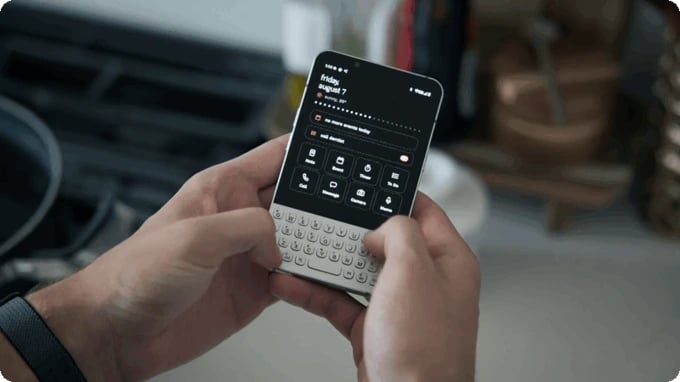
For years, mobile enthusiasts who crave tactile feedback have watched the smartphone market homogenise into an endless sea of glass slabs. While niche vendors have occasionally stepped in with dedicated hardware keyboards, the idea of modular input has remained mostly unrealised since the experimental days of Project Ara. The team behind Sidephone is challenging that status quo by offering a fresh, hardware-first twist on digital minimalism.
Snapping Into Tactile Modularity
Originally conceived as an intentional, distraction-free handset running a streamlined, modified Android operating system, the Sidephone initially built momentum around its swappable lower deck. Unlike conventional handsets locked into a fixed physical footprint, the device relies on magnetic pin connectors that allow users to swap out control panels on the fly. While the unit shipped standard with a traditional T9 numerical keypad, early announcements signaled that the platform would expand into more ambitious territory, as covered in early mobile surveys by CrackBerry.
Rather than confining users strictly to basic numerical dials or minimalist navigation controllers, Sidephone has officially unveiled its plans for swappable compact QWERTY tiles. The announcement provides long-time keyboard loyalists with an intriguing compromise: a device designed to curb doomscrolling that does not compromise on functional text entry when it is time to draft messages or reply to emails.
"Swapping out modular keypads takes just a second, thanks to the magnetic pin connectors."
According to hardware breakdowns from New Atlas and reports from Notebookcheck, the compact QWERTY tile (often referred to as the C-QWERTY) adopts a tight 5×5 grid. Rather than stretching the phone’s chassis into an unwieldy monster, the design uses a hybrid predictive layout reminiscent of BlackBerry’s classic SureType technology, where individual keys host two characters supported by onboard software algorithms. At an accessible price point of $29 per modular tile, it invites tinkerers to change their interface depending on the day's workflow.
How It Stacks Up Against Dedicated QWERTY Phones
For dedicated keyboard purists, the Sidephone remains a distinct species compared to full-blown QWERTY workhorses like the classic BlackBerry Bold, the Key2, or modern Unihertz devices. Because the Sidephone is fundamentally a minimalist modular phone rather than an uncompromised typing powerhouse, its condensed key layout demands reliance on predictive text rather than the effortless, one-to-one tactile precision of a dedicated 35-key physical layout. Nevertheless, for users caught between the desire for distraction-free hardware and the absolute refusal to type on glass, Sidephone's modular middle ground is one of the most exciting experiments to emerge this year.
Curious about how alternative hardware compares to your all-time favorite tactile devices? Head over to our community forums to share your setup, or check out our curated resources section for in-depth comparisons and hardware guides.