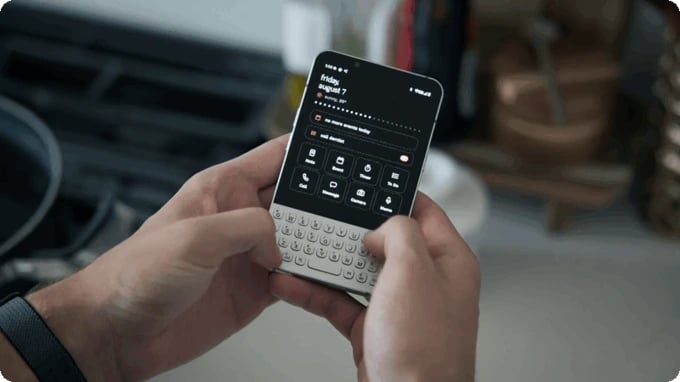
For years, those of us who cut our teeth on the tactile precision of a BlackBerry Bold or Priv have looked at modern smartphones with a touch of melancholy. While monolithic slabs of glass conquered the world, touch typing suffered. Last year, startup Clicks Technology offered a lifeline with form-fitting keyboard cases for iPhones and select Android handsets. Now, the company is casting a wider net with the Clicks Power Keyboard—a universal magnetic sliding keyboard designed for the Qi2 and MagSafe era.
Clicking In: How the Slider Works
Rather than locking you into a rigid, phone-specific case, the Power Keyboard latches onto the back of your smartphone using MagSafe or Qi2 magnetic arrays (or an adhesive ring for handsets lacking built-in magnets). According to reporting from TechCrunch, the accessory retails around $99 and pairs via Bluetooth, working across devices ranging from modern iPhones to the Pixel Fold. When it is time to type, you simply slide your phone upward along the track to reveal a full, backlit QWERTY deck underneath.
As detailed by NotebookCheck, the mechanism allows handsets to be turned into horizontal sliders as well, accommodating both portrait productivity and landscape wide-screen workflows. Inside, a built-in battery pack provides power to the backlit keys while pulling double duty as an emergency wireless charger.
"Clicks Power Keyboard changes the typing experience completely on Android, resulting in fewer typos, freeing up screen space, and giving you a new way to control your smartphone," notes the team on Clicks' official guide.
Real Keys and Screen Real Estate
Typing enthusiasts will recognize the familiar advantages immediately: moving input away from the glass instantly reclaims nearly 50% of screen real estate previously consumed by virtual software keyboards. The Power Keyboard also incorporates a dedicated number row, LED backlighting, and support for desktop-style system shortcuts like Ctrl+C and Ctrl+V. Companion apps allow users to tweak shortcut mappings and dial in power-sharing settings between the accessory and host device.
Of course, turning a modern glass smartphone into a slider comes with real-world tradeoffs. Tacking a battery and mechanical sliding track onto a large phone adds noticeable thickness and weight—tipping the scales around 180 grams on its own. On top-heavy devices, portrait typing requires a deliberate two-handed grip that never quite achieves the effortless, unified chassis balance of a native portrait QWERTY handset.
The Verdict: Slabs vs. True Keyboard Handsets
Compared to true integrated keyboard devices—like the vintage BlackBerry Passport or dedicated QWERTY handsets—a magnetic slider remains an accessory first. You will inevitably face minor hinge play, added pocket bulge, and separate battery management that purposeful hardware never imposed. Yet for enthusiasts forced into modern glass slabs for work or software compatibility, the Clicks Power Keyboard offers the closest thing to a classic slider revival without having to ditch your current daily driver.
Are you picking up the Power Keyboard to rescue your thumbs, or waiting for dedicated hardware? Head over to our community forums to share your setup, or check out our resource guides for the latest tweaks and hardware showdowns.